Cooler Master HAF II 500 in October 2026: worth €185 for a hot gaming GPU, or buy the cheaper mesh case?
The tests are in: GamersNexus put the HAF II 500 at the top of its noise-normalized charts. Here's what that means for a long session on a 300W+ GPU, and when a €120 Lancool 217 is the smarter buy.
Rene Sjeverac
Thursday, October 22, 2026
Three hours into a ranked grind, your 300W-plus graphics card has heat-soaked the case, the fans have crept up, and you're hearing the PC over your teammates. That is the exact problem a case is supposed to solve, and it's the only lens I care about for the Cooler Master HAF II 500.
This isn't a launch story anymore. The HAF II 500 has been out since 13 July 2026, the big reviews have landed, and the street price has settled. So the useful question now is a buying one: is it worth the premium over a cheaper mesh box for a gaming rig that runs hot for hours?
What the testing actually says
GamersNexus ranks it the best-performing case on its noise-normalized charts - the test that matters most to gamers, because it compares cases at the same loudness instead of letting one win by screaming. At that matched noise level its CPU result was 43°C over ambient, the best on the chart, ahead of the Fractal Torrent at roughly 46°C. On the GPU side it was 41.7°C over ambient on the core, a hair behind the Torrent's 40.4°C, but it beat the Torrent on VRAM, 44°C against 45°C. VRM temperatures were the best they tested, 20°C over ambient versus 29°C in the Torrent.
Noise is the other half. With every fan at full speed GN measured 41.4 dBA, quieter than the Torrent (42.3), the Lian Li 217 INF (42) and the HAVN BF 360 Flow (44.5). Tom's Hardware's verdict lines up: impressive airflow, relatively quiet even at 100% fan speed, and the best CPU thermal result in its test group. Overclock3D and Hardware Busters both single out its GPU cooling as a strength.
The reason is the fans. Two 220 mm and one 180 mm Mighty40 units, 40 mm thick, max 1,050 RPM. GN clocked the 220 mm fan at 225 CFM at full speed. Big, slow fans moving that much air is exactly how you keep a hot card fed without the whine.
What that means for your gaming rig
VRAM and VRM temps are the quiet winners here. GDDR7 on a big card runs warm under long loads, and a case that keeps memory and board power delivery cooler at the same noise is doing real work for a session that lasts all evening, not just a 30-minute benchmark loop.
Fit is a non-issue for graphics cards: Cooler Master quotes up to 430 mm of GPU length with the front fans installed. Even the biggest flagship partner cards on the market don't get close to that, so any current high-end card goes in with room to spare.
One correction to the usual spec-sheet line: the case itself has no RGB lighting. What ships is a fan hub with six PWM and six ARGB headers (54W total), so lighting is something you add, not something you get.
The price check, and the catches
At the time of writing Alternate lists it at €184.90 in Germany and €186.90 in France, against a US MSRP of $200. The obvious cheaper alternative is the Lian Li Lancool 217, sitting around €120 in German price comparisons, with five fans included and back-connect motherboard support. GamersNexus itself points value-minded buyers to the Lancool 207 or 217.
The HAF II 500's catches are real. It's about 56 cm deep and 262 mm wide, so measure your desk. No back-connect boards. GN calls the cable-strap hooks flimsy, dislikes the non-captive thumbscrews, and notes that in practice it's an air-cooling case with radiator support realistically limited to the top. And 220 mm fans aren't something you pick up at any shop if one dies years from now.
My call: if your rig pairs a 300W-plus GPU with long sessions and you hate fan noise, the roughly €65 premium over a Lancool 217 buys measurable results - better VRAM and VRM temps at the same noise, and a quieter top end. If you're running a mid-range card, want a hidden-cable build, or would rather put €65 toward a faster GPU, the Lancool is the better spend. Frames come from the GPU. The case only decides how loud they are.
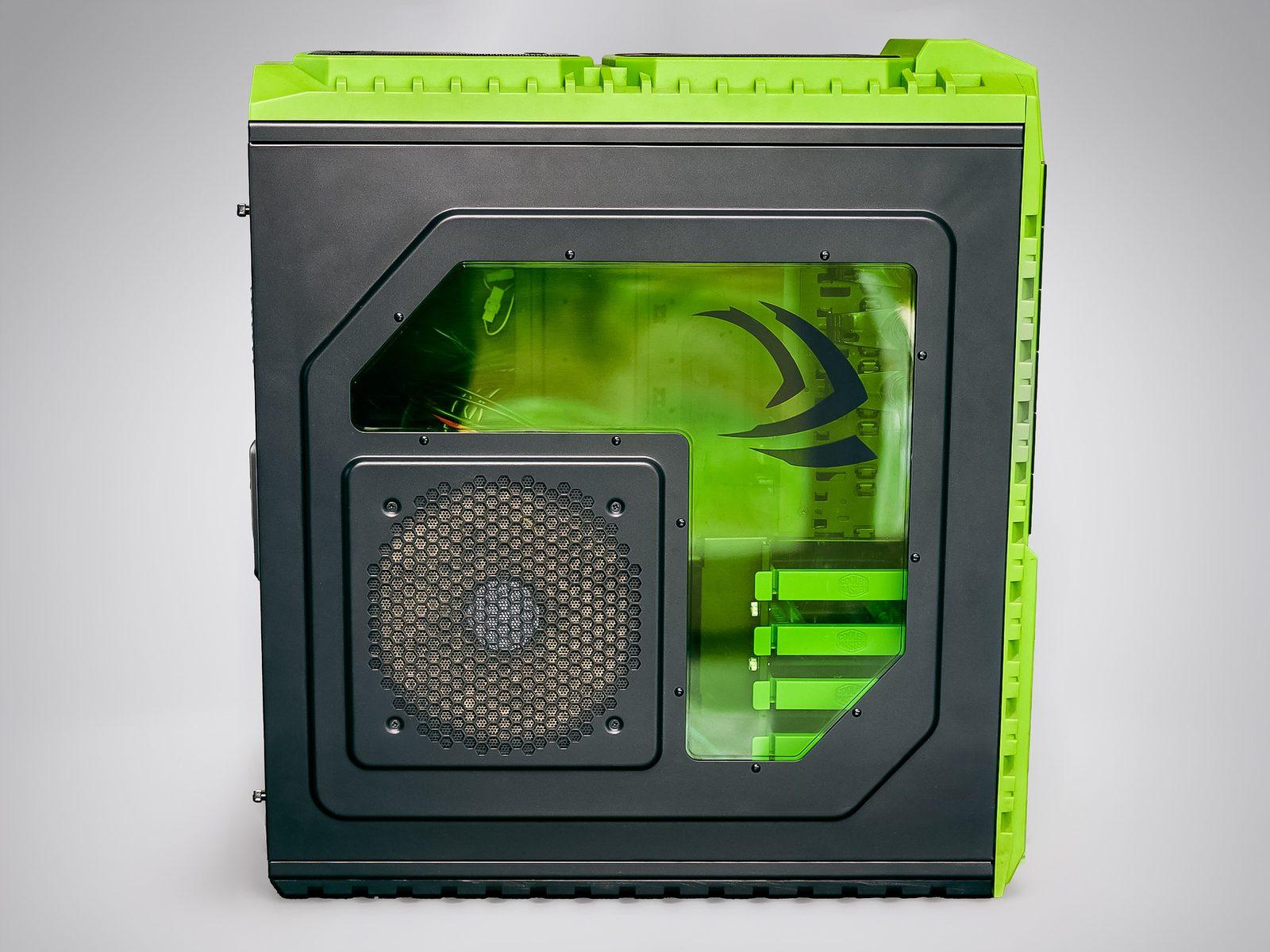
Image: DYVER / CC BY-SA 4.0, source: https://commons.wikimedia.org/wiki/File:CoolerMaster_HAF_X_nVidia_Edition_PC_Geh%C3%A4use_-_02.jpg