
DLSS 5 Leaked Early, and the Frame Budget Is the Part Nobody's Talking About
An unfinished DLSS 5 build escaped into the wild and modders shoved it into everything. The internet is busy laughing at 'Claude Strife' - but the number that actually matters is the performance cost.
Rene Sjeverac
Saturday, August 29, 2026
Everyone's laughing at Cloud Strife. I'm looking at the frame time.
An unfinished DLSS 5 build leaked out of an NBA 2K27 early access build, modders traced it to a runtime library called `nvngx_dlssnr.dll`, and within hours the RenoDX crowd had it injected into Control, Skyrim, Final Fantasy VII Rebirth and GTA: San Andreas. The screenshots went viral because a generative model turned Cloud into something the internet immediately nicknamed "Claude Strife," and turned CJ into a face you really don't want rendered at 4K. Fair enough. It's funny.
But buried in the same round of experiments is the number that actually matters: one modder reported an almost 50% performance loss.
Fifty percent. On an unfinished, unoptimized build injected where it was never meant to run - caveats fully acknowledged, this is not the shipping product and it isn't fair to benchmark it as one. But it tells you what class of workload we're dealing with. DLSS 1 through 4 sold themselves on giving you frames back. This thing conditions on the frame you already rendered and spends *more* compute making it prettier. That's a fundamentally different trade, and if you've spent any time chasing 1% lows you know exactly which side of it you live on.
What Nvidia pitched vs. what leaked
The official version, from Nvidia's SIGGRAPH showing, is far more disciplined than the meme suggests. The renderer draws the frame as the artists authored it, then a compact model enriches the final appearance - lighting, materials, high-frequency detail - conditioned on what the engine actually drew rather than on a text prompt. Developers get three selectable models, per-scene selection, sliders for structure and tone intensity, and per-object masking, so a character's face can be excluded while the wet asphalt behind them gets the full treatment. Nvidia's stated design constraint is roughly a 16 ms frame budget at 4K60.
That last detail is the whole argument. Sixteen milliseconds is 60 fps. My monitor doesn't run at 60. Neither does yours, if you're reading a site like this one. At 240 Hz I have 4.16 ms per frame for everything - engine, presentation, the entire input path. A pass that assumes it gets to share a 16 ms budget isn't aimed at me, and I don't think Nvidia is pretending otherwise.
So the leak is really a story about two audiences colliding. The masking controls, the intensity sliders, the per-object exclusions - all of that exists precisely because the tech mangles faces when you let it run unsupervised. Modders ripped out every guardrail and then acted surprised that a semantic model with zero art direction turned a spiky-haired mercenary into a skincare ad. That's not an indictment of DLSS 5. It's an indictment of injecting a DLL into games it was never trained or tuned for.
What I want before this ships this fall is honest frame-time data. Not average fps in a marketing bar chart - percentile frame times, pass on and off, at the resolutions and refresh rates people actually compete at. Nvidia has been reasonably good about publishing latency numbers for Reflex. This deserves the same treatment, because "looks closer to photorealistic" is a claim you evaluate with your eyes, and "costs you X milliseconds" is a claim you evaluate with a capture card.
The Cloud screenshots will be forgotten in a week. The frame budget question won't.
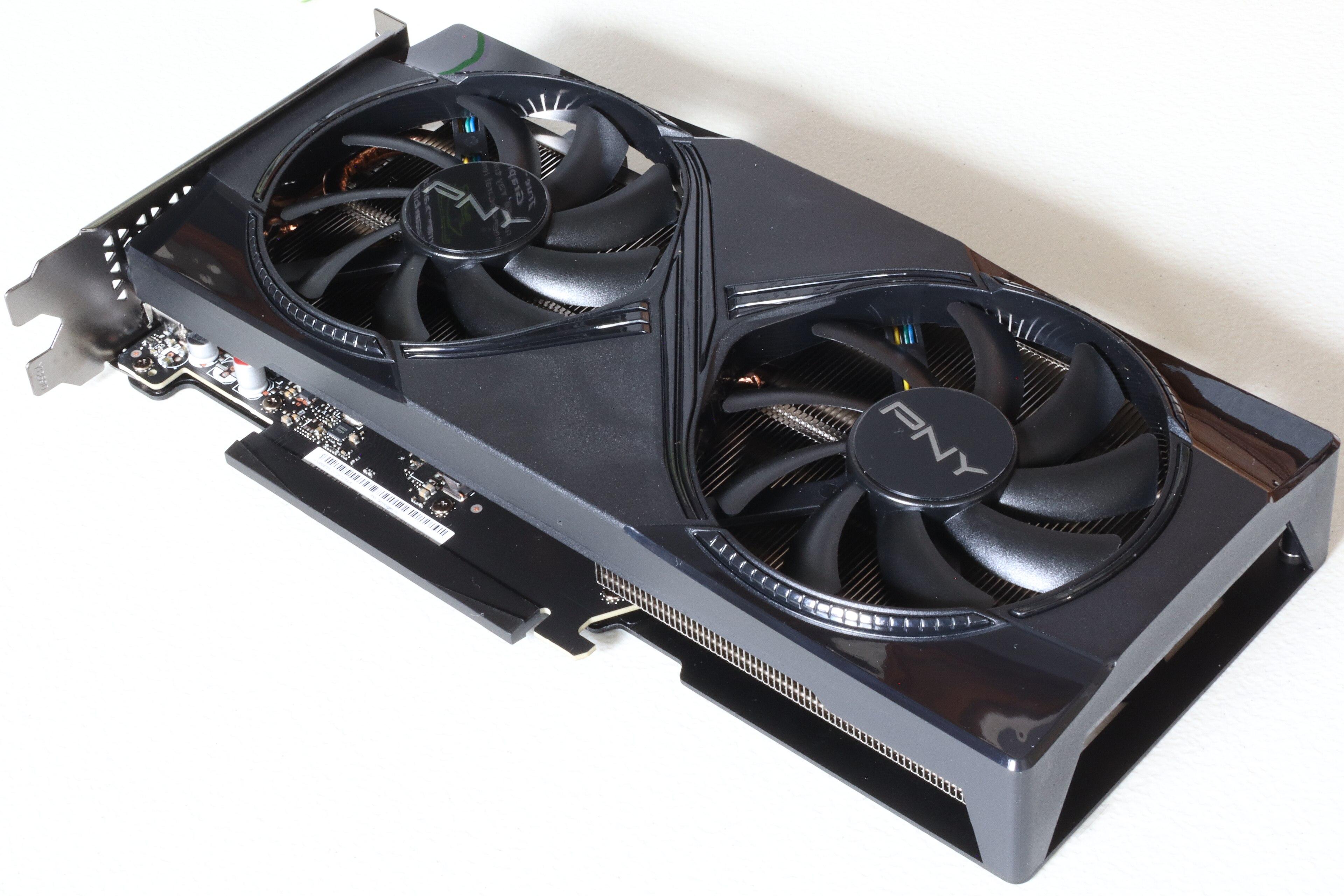
Image: FreeMediaKid! / CC BY-SA 4.0, source: https://commons.wikimedia.org/wiki/File:Nvidia_GeForce_RTX_5060_Ti_16GB,_PNY_Overclocked_Dual_Fan,_front.jpg