
Take-Two's CEO Bets on Streaming in 3 Years. Latency Says Not Yet
Strauss Zelnick says the industry hits commercial streaming mode within three years and multiplies its install base tenfold. He's right about where hardware prices are heading - but 'low-latency' is doing an enormous amount of work in that sentence.
Rene Sjeverac
Saturday, August 8, 2026
Three years. That's the number Strauss Zelnick dropped on Take-Two's latest earnings call: the industry will be "in commercial streaming mode in 3 years," cloud gaming finally reaches low-latency viability, and the effective installed base multiplies roughly tenfold because, as he put it, machines that weren't game machines before become game machines.
I've spent too many evenings pulling apart frametime graphs to hear the phrase "low-latency streaming" without twitching. It's the load-bearing beam of that entire prediction, and it's carrying more weight than everything else in the sentence combined.
Give him this much, though: the pressure he's describing is completely real. Hardware has been moving the wrong direction for a while now. Tariffs, TSMC wafer pricing and a memory market getting hoovered up by AI datacenter buildouts have all pushed component costs up instead of down. A console generation that launched around the $500 mark could plausibly land a lot closer to four figures next time, and Zelnick himself acknowledged that kind of pricing could cap the company's addressable market. If you can't get a box into a living room, renting one out of a rack an hour away starts to look like sound business rather than a Stadia rerun.
Now the annoying part about milliseconds
Latency isn't one number. It's a stack, and streaming bolts an entire extra floor onto it.
Locally the chain runs mouse to USB poll to engine tick to render to present to panel. That's already the thing competitive players throw money at to shave. Push it through a datacenter and you add upstream transit for the input, a server-side render, a hardware encode pass, downstream transit, a client decode, and only then the present. Physics sets a floor underneath all of it - light in fiber moves at roughly two thirds of c, so even a few hundred kilometres of round trip costs milliseconds you can never optimize away, and real routing is never a straight line.
Honestly, the average isn't even what kills you. Jitter is. A stable 45 ms is something your brain quietly compensates for after twenty minutes. A stream sitting at 35 that spikes to 90 every time someone in your building starts a 4K upload wrecks your muscle memory, because aim is a learned prediction loop and you cannot train against a moving target. Layer encoder artifacts onto a smoke edge or a fast flick and you're not merely slower - you're getting worse visual information at the precise moment you need it most.
Better networking gear trims the transit slice of that budget. It doesn't delete the encode and decode round trip, and it definitely doesn't make your neighbour's torrent client polite.
Here's where I'll meet Zelnick halfway: he isn't describing me, and he probably isn't describing you if you're reading a site like this. That tenfold figure is about people who currently own zero gaming devices - phones, cheap laptops, TVs, anything with a decoder chip in it. Someone playing a story-driven open-world game on a television genuinely will not notice 60 ms, and that audience is enormous. He was also careful to say revenue won't scale tenfold alongside the install base, which is quietly the most honest part of the whole segment.
So the version of this I'd actually put money on isn't "we'll all be streaming." It's streaming as the on-ramp: the trial, the demo, the way GTA 6 reaches someone who was never buying a console in the first place. The rest of us keep tuning locally, because the numbers still favour a box under the desk by a wide margin.
I'll change my mind the day I can't feel the difference on a deathmatch server. And I'll post the frametime capture when it happens.
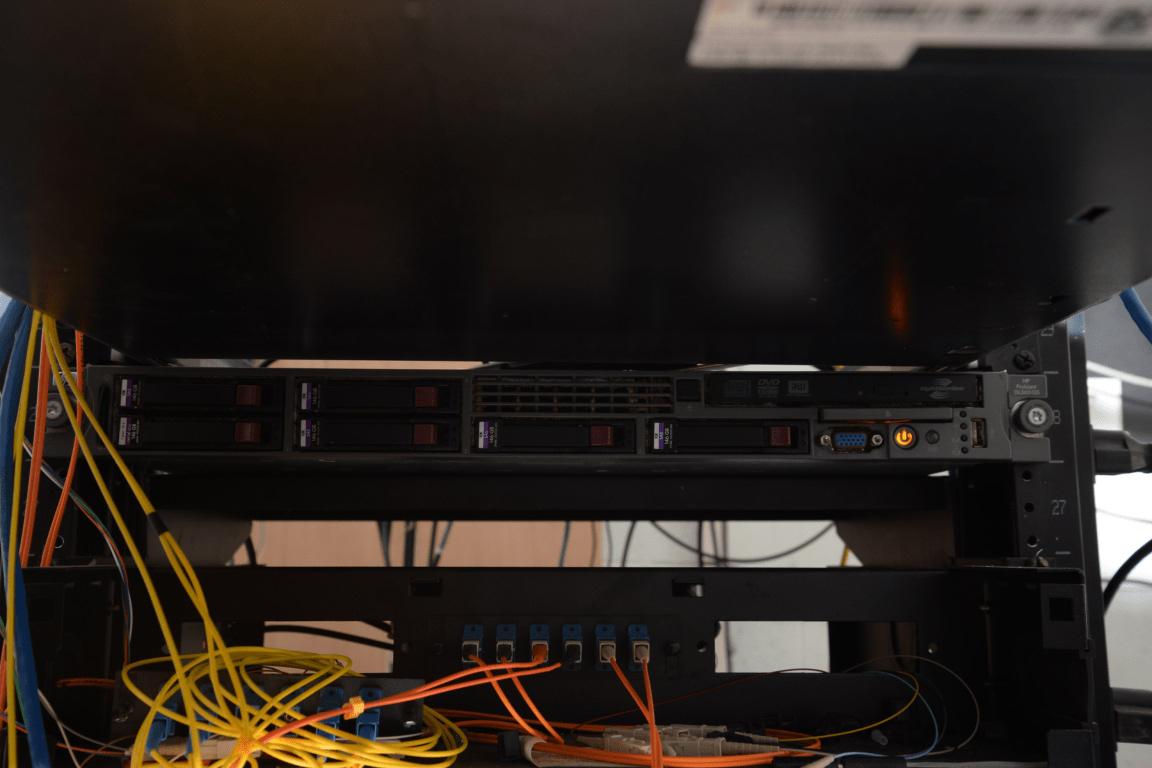
Image: Federal Bureau of Investigation / Public domain, source: https://commons.wikimedia.org/wiki/File:EFTA00002518_-_Server_rack_with_multiple_hard_drives_and_network_cables_connected_in_a_data_center_environment.jpg